
Lisa Chamberlain James and Julia Cooper / Trilogy Writing and Consulting, Cambridge, United Kingdom; Parexel International, Dublin, Ireland
Abstract
Medical writers play a crucial role in regulatory submissions, ensuring clarity, adherence to guidelines, and over-all document quality. In 2021, AMWA’s working group reported on the value of the contribution of medical writers across the pharmaceutical industry. This included a sub-group tasked to gather data on the perspective of regulatory agencies about the effect of document quality on the regulatory review process, awareness of the contribution of medical writers to the quality of regulatory documents, and the current strengths and opportunities to optimize document quality. This survey confirmed that well-written documents streamline the review process, whereas poor-quality submissions cause delays. With the advent of artificial intelligence (AI), medical writing is undergoing a transformation. This article discusses how regulatory agencies and the pharmaceutical industry may adapt to AI and how the role of medical writers is evolving to integrate technological advancements while upholding the high-quality standards required for successful submissions.
Introduction
The value of medical writers in regulatory submissions is widely acknowledged, with our expertise contributing to document clarity, consistency, and adherence to regulatory expectations. The 2021 AMWA Value of Medical Writing survey showed that many regulatory reviewers understand the role of medical writers, believe that they increase the quality of the documents sent to the agencies for review, and make the job of the regulatory reviewer easier. Document quality was highlighted as a key compo-nent in reviewers’ assessments, and poor quality had the potential to bias reviewers against subsequent submission documents from the same sponsor. Regulatory reviewers also appreciated and recognized the work and importance of trained medical writers, who aim to produce documents that are as concise and strategic as possible. Given that there are not enough trained medical writers to meet the demand of the pharmaceutical industry, and that there is an increasing need for speed and efficiency, it is no surprise that medical writing is seen as a good opportunity for augmentation with artificial intelligence (AI).
The last few years have seen a plethora of AI tools being produced to aid various aspects of medical writing. This article investigates how the skill sets of medical writers could combine with the new technology and suggests how medical writers can continue to support review by regulatory agencies while they adapt to using the tools themselves and assess information provided to them using new technology.
AI and Document Quality in Regulatory Submissions
This field is moving so fast that at the time of writing, even ChatGPT struggled to identify the number of tools that could be used for medical writing:
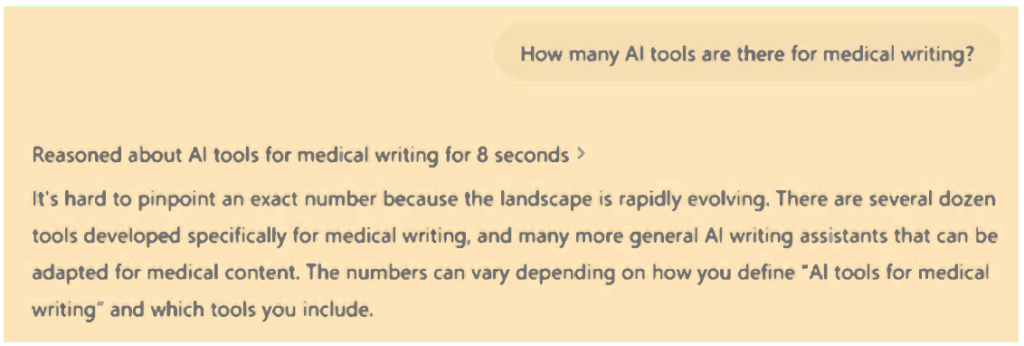
Figure 1. ChatGPT query and response.
Therefore, a detailed discussion of the available tools is not only outside of the scope of this article but would likely be out of date before the article even went to print. However, there are commonalities among all tools in what they offer and the advantages they bring to medical writers. These advantages are worth investigating with an eye to the future and in light of the 2021 survey results.1
The 2021 survey found that 87% of regulatory reviewers believed that poor-quality documents impeded their assessments, and 77% confirmed that poorly written submissions delayed approval processes. The same survey highlighted excessive length, lack of clarity, and poor explanation of rationale as the most common quality issues affecting regulatory review. Regulatory reviewers consistently emphasized the need for well-structured, concise documents with clearly articulated rationales.
Although acquiring years of experience and honing the medical writing skill set is undoubtedly needed to produce regulatory documents of high quality, AI can support medical writers in achieving document quality objectives in several ways:
- Consistency and Adherence to Standards: AI tools can check for consistency in terminology, grammar, and formatting across lengthy submission documents, reducing variability and improving readability.
- Clarity and Conciseness: AI-driven natural language processing tools can help identify redundant or verbose sections, ensuring that key messages remain clear and impactful.
- Automating Repetitive Tasks: AI can generate tables, summarize data or source documents, and cross-reference information within large submission dossiers, allowing medical writers to focus on refining strategic content.
- Quality Control and Compliance: Al can check adherence to regulatory guidance documents, flagging potential inconsistencies before submission.
However, it should be noted that although these capabilities improve efficiency, there are risks associated with the use of AI tools that should be considered. Clinical data are regarded as highly sensitive, both commercially and to protect the rights of clinical trial participants. Any tool using these data should be ringfenced so that data cannot be used in nonprotected environments. Because these models learn from data, there should be an awareness of the datasets that different large language models are learning from. Additionally, recent concerns have been raised around ethics and bias3 because AI tools generating de novo text are at risk of bias, misinformation, and plagiarism. Tools are also not constantly updated in terms of their knowledge, so it is important to ensure that the AI tool being used is accessing the latest medical knowledge.
Medical writers remain essential for contextualizing data, crafting persuasive narratives, and ensuring compliance with regulatory expectations. Their role will also encompass ensuring accuracy (the detection of hallucinations), which will necessitate transparency and traceability within any Al tools used.
Regulatory Agencies and AI
Regulatory agencies are also evolving in response to AI advancements. Some agencies have begun exploring AI-based tools to assist in document review and data analysis. However, regulators remain focused on transparency, requiring that Al-assisted submissions maintain clear authorship and traceability.2
Medical writers must ensure that AI-generated content not only adheres to these standards and aligns with regulatory expectations but that they are aware of any updates or additions to the guidance and laws surrounding the use of AI so that they remain compliant. With the speed of AI development, it will be important for medical writers to keep track of the ever-evolving AI regulations. As the industry and regulatory agencies adapt to the use of Al, medical writers will play a crucial role in guiding the integration of these tools while preserving the integrity and clarity of regulatory documents.
The Convergence of Medical Writer and AI Tool
As AI becomes more integrated into medical writing, the role of medical writers will evolve to showcase the strategic and critical thinking skill set that is the core of high-quality medical writing. Medical writers will increasingly focus on shaping the overall messaging and regulatory strategy of submissions, ensuring alignment with agency expectations, and that the key messages are supported by the data being presented.
Rather than drafting from scratch, writers may use AI-generated content as a starting point, refining and contextualizing it to meet regulatory and scientific standards. The first draft of this article was augmented by an AI tool that helped the authors to search for and summarize a large amount of information. Although not all of the output was useful or accurate, it still saved some time to get to first draft. As the potential of these tools increases, so do the accompanying use cases. Medical writers can use AI tools for everything from first drafts, to helping to manage review cycles, planning for drafting meetings, literature searching and summarization, calendar management, and email drafting.
Although AI tools can process large datasets, they lack the ability to draw meaningful conclusions because they cannot contextualize. Although summarization and even suggested conclusions can be extremely helpful and time efficient, each must be carefully reviewed and context added by a human mind. Therefore, medical writers will continue to synthesize complex scientific information into coherent narratives that facilitate regulatory review. However, AI tools will undoubtedly streamline routine administrative and summarization tasks, and this will allow medical writers to work more closely with regulatory affairs professionals, statisticians, and subject matter experts at a much earlier stage in the process. This will also enable clinical teams to refine submission content much earlier and with live data available earlier in the process rather than having to use estimated or dummy data in the early stages.
Of course, to be able to effectively use AI tools while maintaining high-quality standards, medical writers will need to develop new skills, including AI literacy and prompt engineering. Developing this new skill set will require inter-action with groups that have been very separate from the medical writing teams to date. Computer scientists, AI engineers, and technical departments will be more involved in helping medical writers to craft the prompts to make sure that the correct outputs are generated or training the writers to effectively generate prompts themselves. Medical writers will have to embrace learning a new language to get the best from the AI tools available to them. The use of sandboxes to train and teach users of AI tools can be really useful, but it should be noted that this will take time and effort. Writing prompts can take as much time as writing the text manually (although prompts can be refined and re-used), but it is not intuitive. Libraries of prompts are now available, some behind pay walls, and there is also an environmental as well as a monetary cost to using these tools that should not be overlooked.
AI cannot replace the strategic insight and expertise that medical writers bring to regulatory submissions or the leadership skills needed to manage the review cycles and cross-functional team interactions that form a substantial part of the submission development process. Instead, AI should be seen as an enabler, streamlining processes and allowing writers to focus on higher-value tasks. Used correctly, AI tools have the potential to support medical writers, improving efficiency and mitigating resource constraints. However, the core skills of medical writers-critical thinking, strategic messaging, project management, and regulatory expertise-remain essential.
The Future
Although growing at an exponential rate, we are still in the discovery phase of how best to work with AI in the medical writing field. Both writers and regulatory agencies will need to navigate these waters carefully to maximize the gains and minimize the risks-some of which we may not be aware of yet.
However, it is clear that AI tools are here to stay, and that is not a bad thing. AI was used to help craft the first draft of this article, and even after thorough checking, the authors still saved some time.
AI is not a replacement for medical writers but a valuable tool that can enhance efficiency, improve document quality, and alleviate resource constraints in regulatory submissions. Used correctly, AI can support writers in reducing redundancy, ensuring consistency, and automating tedious tasks. However, the expertise of medical writers remains irreplaceable for strategic messaging, data interpretation, and compliance with evolving regulatory expectations.
The necessary qualities for a successful submission have not changed-regulatory reviewers still need to see clear, succinct, well-supported arguments in the dossiers they review. By embracing AI as a partner rather than a replacement and by keeping an open mind to possible use cases (such as the automation of emails and review cycles), medical writers can continue to drive the delivery of high-quality submissions that facilitate efficient regulatory review and, ultimately, improve patient access to new therapies.
It is clear that AI is, and should be, part of a medical writer’s future and tool kit. AI tools can offer substantial advantages when used correctly. Medical writers should adapt and adopt in order to not only survive but thrive.
Disclaimers
AI software was used to create the first draft of the article. The authors affirm that the original intent and meaning of the content remained unaltered during editing and that this software had no involvement in shaping the intellectual content of this work. The opinions expressed in this article are the authors’ own and not necessarily shared by their employers or AMWA.
Author declaration and disclosures: The authors note no commercial associations that may pose a conflict of interest in relation to this article.
Author contact: Lisa@trilogywriting.com
References
- 1. Cooper J, Chamberlain James L, Affleck J, Bass B, Forjanic Klapproth J, Harris D. Value of medical writing: the regulator’s perspective. Am Med Writ Assoc J 2021;36( 4):145-151. doi:10.55752/ amwa.2021.83
- 2. Brave new world: authorship and AI in medical writing. AMWA. Published September 11, 2023. Accessed June 10, 2025. https://blog.amwa.org/brave-new-world-authorship-and-ai-in-medical-writing
- 3. Doyal AS, Sender D, Nanda M, Serrano RA. ChatGPT and artificial intelligence in medical writing: concerns and ethical considerations. Cureus. 2023;15(8):e43292. doi:10.7759/ cureus.43292