
The ICH M11 guideline introduces a globally harmonised, structured approach to clinical trial protocol development, transforming medical writers from narrative authors into strategic, data-driven architects and redefining their role in an increasingly digital regulatory landscape.
Bhawna Basin and Giulia Angelini at Trilogy Writing & Consulting
Clinical trial protocols are the backbone of study design, execution and regulatory review. In the past, protocols have largely been written as narrative documents, with significant variability in structure, content, and terminology across sponsors and regions. This lack of consistency has led to inefficiencies in protocol development, challenges in regulatory review, increased manual effort, and limited interoperability with digital and regulatory systems like the Clinical Trials Information System, the Food and Drug Administration Electronic Submission Gateway, etc. This has resulted in delayed trial initiation and patient access.
The introduction of the ICH M11 guideline represents a significant milestone in modernising protocol authoring. ICH M11 introduces a globally harmonised, structured and electronic approach to protocol development, designed to improve consistency, enable digital exchange, content reuse and support more efficient clinical research.
What is ICH M11?
ICH M11 is an internationally harmonised guideline that defines a standardised, structured and electronic clinical trial protocol format, known as the Clinical electronic Structured Harmonised Protocol (CeSHarP). The guideline provides both a harmonised protocol template and a detailed technical specification, creating a common framework for how protocol information is organised, expressed and exchanged electronically.1,2 By defining not only what information belongs in a protocol but also how it should be structured, ICH M11 supports consistency across studies and sponsors, and enables digital interoperability between clinical systems.
Why is ICH M11 needed?
Prior to the introduction of ICH M11, the TransCelerate clinical trial protocol template (CPT) was widely used; however, as a voluntary and non-mandated standard, it was inconsistently implemented across sponsors. Sponsors adapted the CPT to align with their internal processes, legacy templates and preferences, resulting in variability in protocol structure and content.
Scope and what is out of scope
ICH M11 applies to interventional clinical trials of drugs, vaccines, and drug-device combinations intended to be registered as medicinal products. It is suitable for all phases of clinical development and across all therapeutic areas. Importantly, ICH M11 does not define the processes for protocol development or maintenance, nor does it replace other ICH guidelines such as E6, E8 or E9. Instead, it complements existing guidance by standardising how required protocol content is structured and presented.
The three core components of ICH M11
ICH M11 comprises three closely related components: the guideline, the CeSHarP protocol template and the technical specifications.
The ICH M11 guideline
The guideline outlines the rationale and principles for a standardised protocol format. It promotes a harmonised, regulator accepted structure that supports electronic data exchange.
The CeSHarP protocol template
The CeSHarP template is a global standardised template for interventional clinical trial protocols. It applies across all phases and therapeutic areas and introduces a strict heading hierarchy with defined section order. A key innovation of the template is the use of four distinct text types:
- Universal text, which must remain exactly as written
- Conditional text, included only when specific conditions apply
- Optional text, added at the author’s discretion
- Controlled terminology, selected from predefined, regulator recognised value sets.
The template also introduces structured, machine readable fields, indicated by square brackets, which enable electronic interoperability when combined with the technical specifications. The protocol content is organised into a clear main body and appendices, covering areas such as objectives and estimands, study design, population, interventions, safety reporting, statistical considerations, oversight and region-specific differences.
The technical specifications
The CeSHarP technical specification provides a digital format for writing protocols and enables interoperable exchange of protocol information. In practice, the technical specification is not intended to be used as a standalone authoring tool but as a reference that defines how each protocol component should be structured and represented in a machine-readable format. A practical approach for medical writers is to draft using the CeSHarP template and consult the technical specification when clarification is needed on specific elements. For example, a simple element such as the protocol title is defined in the technical specification as two linked components: a header (the section label) and a data field (the actual title text), with attributes such as data type (text), cardinality (single entry) and requirement status (mandatory).
While medical writers will typically only enter the title in the template, the technical specification ensures that this information can be consistently interpreted by downstream systems.
This illustrates that the specification operates largely in the background, guiding structure and consistency rather than changing the visible drafting process.
Alignment with CDISC standards
ICH M11 closely aligns with Clinical Data Interchange Standards Consortium (CDISC) standards. CDISC manages the controlled terminology for ICH M11, ensuring governance and public access. This alignment supports consistent data, terminology and structure, enabling smooth information flow from protocol authoring to data collection, analysis and submission.
Key features that matter to clinical teams
Several features of ICH M11 represent meaningful shifts in how protocols are designed and reviewed:
- Mandatory core sections combined with optional, study specific flexibility
- Explicit capture of participant input in trial design
- Enhanced statistical content aligned with ICH E9 principles
- Structured handling of country and region-specific differences without separate protocol amendments.
Together, these features support a clearer, more consistent and execution-focused protocol model.
Comparison with the TransCelerate common protocol template
While both the TransCelerate common protocol template and ICH M11 aim to improve protocol quality and consistency, there are key distinctions. ICH M11 is a formal regulatory guideline, endorsed through the ICH process, with mandatory technical specifications for structured, machine-readable protocols. TransCelerate, by contrast, remains a voluntary industry standard. TransCelerate CPT v11 is provided in Word format, unlike the ICH M11 guidance, which is available as a PDF. The TransCelerate CPT v11 has been designed to align closely with ICH M11.
Implications for medical writers
The adoption of ICH M11 represents a meaningful shift in how clinical trial protocols are authored, reviewed and maintained. While its full digital vision will develop over time, several practical implications are already affecting daily work for medical writers. The rest of this article explains what ICH M11 means for medical writers both in terms of immediate workflow changes and the longer-term skills required.
From narrative flexibility to structured authoring
A key change is the shift from largely narrative, sponsor-customised protocol drafts to a more standardised, structured approach to authoring. Before ICH M11, medical writers typically selected or adapted a sponsor-specific template and discussed the format with the client. With ICH M11, medical writers work with four text types – universal, conditional, optional and controlled terminology, each identified by formatting that indicates how it should be used. Medical writers must learn to recognise these categories by their visual cues in the CeSHarP template (font, colour and bracket conventions) and apply the corresponding rules without deviation. Misapplying these categories, for example by paraphrasing universal text or replacing a controlled term with a synonym, can lead to non-compliance.
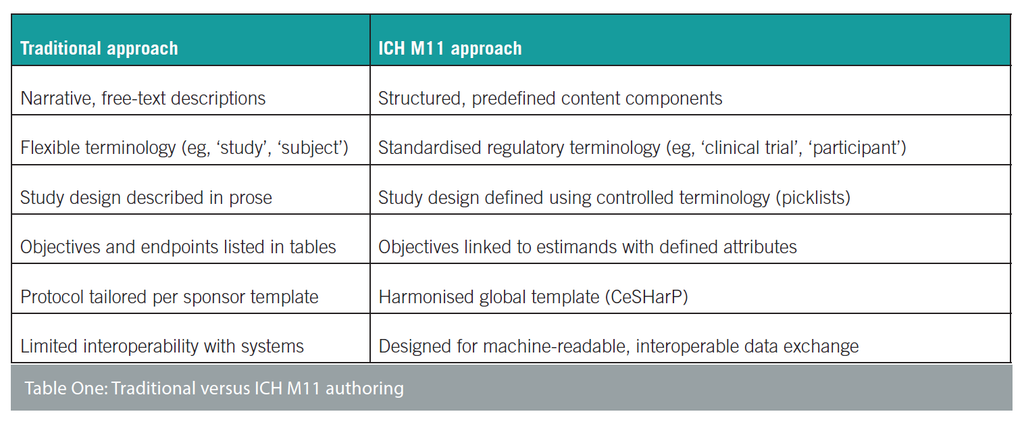
A new task is selecting terms from controlled lists maintained jointly by ICH and CDISC. In practice, the writer encounters fields such as Trial Phase, Intervention Model, Trial Blind Schema, Blinded Roles, Primary Purpose and Intervention Assignment Method, where values must match the ICH M11 controlled terminology rather than being expressed in free text. To further illustrate the practical impact of ICH M11, it is helpful to consider how protocol development shifts from narrative to structured authoring in specific scenarios. For example, elements such as study design, which were previously described in free text, are now defined through selection from controlled terminology lists (eg, intervention model, blinding and geographic scope).
Similarly, traditional objective and endpoint tables are replaced by estimand-focused structures that require closer collaboration with statisticians. Even terminology changes (eg, ‘subject’ to ‘participant’) must be applied consistently as regulatory requirements rather than stylistic preferences. Collectively, these examples highlight a broader transition from descriptive writing to structured, data-aligned protocol authoring.
Becoming proficient in controlled terminology and metadata
The adoption of ICH M11 is changing how clinical trial protocols are written, reviewed and maintained. While full digitalisation is still evolving and its timeline remains unclear, early use and training are important. Medical writers are already seeing workflow changes and building skills now will be key for future fully digital protocols.
Terminology as a regulatory requirement, not a style choice
ICH M11 requires specific terminology that replaces long-standing conventions. ‘Subject’ becomes ‘participant’, ‘study’ becomes ‘clinical trial’, and ‘study drug’ becomes ‘trial intervention’ (Table One). These are not optional style preferences; they are regulatory requirements. Medical writers working from legacy drafts or older protocol templates will need to update terminology early in the process and become familiar with the approved value sets for items such as study phase, intervention model, blinding and amendment reason.
Digital implementation: what remains unclear
Beyond changes in terminology and structure, ICH M11 also introduces important considerations related to the digital representation of protocols.
While ICH M11 introduces a structured, machine-readable protocol format, its full digital implementation is still evolving in practice:
- Conversion of protocols into M11-compliant digital formats will require specialised tools and systems and may increasingly involve automation or AI-supported workflows
- At present, a fully standardised approach to digital protocol authoring and submission is not yet established across the industry
- Digital submission is not currently mandatory; however, organisations should expect increasing regulatory and operational pressure towards digitalisation over time, driven by the need to enhance content reuse, improve harmonisation, and increase efficiency in protocol development and regulatory processes.
Navigating key structural changes
Several structural changes in the M11 template have direct implications for medical writers’ planning and drafting workflows:
- Synopsis: The synopsis is no longer a stand-alone document. It should now be a brief, layperson-accessible summary of objectives (approximately half a page) with cross-references to the full detail in Section 3. Writers must shift from a cut-and-paste approach to genuine summarisation
- Objectives and estimands: ICH M11 requires a dedicated estimand table for each objective, structured according to ICH E9(R1) principles. The traditional objectives/endpoints table is replaced; endpoints now appear as attributes within the estimand framework. This demands closer collaboration with biostatisticians during drafting and a solid working knowledge of the estimand concept
- Safety reporting: Adverse event definitions and reporting rules are now included in the protocol body rather than appendices, and pregnancy reporting has been elevated to its own Level 2 heading. This reorganisation requires writers to rethink section planning early in the outline stage
- Abbreviations: The abbreviation list is now placed in an appendix under a Level 1 heading and is treated as the point of first use. Abbreviations should not be defined again in the main text, so writers should explain this change to teams early on.
Integrating quality by design into the writing process
ICH M11 is not a standalone guideline. Its alignment with ICH E6(R3) and E8(R1) means that medical writers are expected to engage with Quality by Design principles from the outset.3,4 In practice, this means raising questions about critical-to-quality factors at kick-off meetings, ensuring that risk management content in the protocol reflects genuine risks to patient safety and data integrity, and checking that procedures are proportionate to the study’s risk profile. Stakeholder input into trial design, including patient involvement, is now a documented expectation, with a designated place in the protocol (Section 4.1.1). Medical writers are well placed to champion this requirement by asking clinical teams, ‘has there been patient input, and how do we document it?’
A strengthened professional role
Although the transition to M11-aligned authoring entails a short-term learning curve and additional workload, it also highlights the strategic role of medical writers. As protocols become more structured and standards-driven, the ability to navigate controlled terminology, follow rules, and coordinate across clinical, regulatory and data management functions becomes more important. Medical writers who invest in M11 fluency now – while adoption remains recommended rather than mandatory – will be best prepared to lead when the guideline becomes mandatory.
References:
- Visit: ema.europa.eu/en/documents/template-form/ich-m11-clinicalelectronic-structured-harmonised-protocol-
cesharp-template-step-5_en.pdf - Visit: ema.europa.eu/en/documents/regulatory-procedural-guideline/ichm11-clinical-electronic-structured-harmonised-
protocol-cesharp-technicalspecification-step-5_en.pdf - Visit: database.ich.org/sites/default/files/ICH_E6%28R3%29_Step4_FinalGuideline_2025_0106.pdf
- Visit: database.ich.org/sites/default/files/E8-R1_Guideline_Step4_2021_1006.pdf
Bhawna Basin is a senior medical writing manager at Trilogy Writing & Consulting. Bhawna brings over 15 years of experience in clinical development and scientific research across a broad range of therapeutic areas. With a background in pharmacy and clinical research, Bhawna began her career in academia in India, where she spent three years before transitioning to the pharmaceutical industry, specifically in drug regulatory affairs. In 2013, she moved to Germany and changed careers to become a medical writer. Over the past 11 years, she has developed a deep passion for medical writing. While she is not a clinician, she finds fulfilment in contributing to patient care by writing clear, concise documents that facilitate faster approvals.
Giulia Angelini is a senior medical writer at Trilogy Writing & Consulting with over ten years of experience in regulatory writing, clinical research and scientific communication. Following a PhD in Cellular and Molecular Clinical Research, she began her career as a research associate before moving into leadership roles in both industry and academia, including vice president of Research and Development and Adjunct professor. Over the past five years, she has focused exclusively on medical writing, specialising in translating complex scientific data into clear, evidence-based content that supports informed decision-making and innovation.