
How medical writing has shifted from a technical function to a strategic role in which writers act as specialists and advisors helping communicate key messages across documents and keeping teams focused on shared goals
The idea of strategic medical writing is not new. Coined as a concept in 2011, it defines a way of working that goes beyond what many medical writers were doing at that time, and that some continue to do today.1 It reflects the strategic element that writers bring to the process of crafting text and interacting with authoring teams. Strategic medical writing is the intersection of collaboration, storytelling and project management applied to produce clear, focused and timely documents that support the clinical and regulatory goals of projects. It describes the critical role medical writers can play on authoring teams to support clear and effective crystallisation and communication of a company’s messaging. At the time, it was a call to action to have medical writers as integral parts of the clinical teams throughout a clinical development programme.
The origins and evolution of medical writing
For decades, medical writing was a function that brought data correctly to paper and ensured documents were well formatted, followed company style guides and were compliant with ICH guidelines. This was already an evolution from the early role of medical writers, which was primarily an editorial function. After World War Two, when the medical field was expanding rapidly and the need to communicate rapidly expanding science grew beyond what physicians could write on their own, writers and editors were brought on board to help write manuscripts and disseminate the wealth of data being gathered.2
Following on from that, as regulatory guidelines and regulations developed in the pharmaceutical industry, clinicians were confronted with numerous, often complex documents and there wasn’t
enough time to get them all written. In the 1980s the industry recognised the benefit of having writers assist in preparing these regulatory documents and medical writers stepped in to fill that need.3
Medical writing as a professional service has thus served the medical profession for over half a century as a means of providing editorial input, making sure documents are compliant with journal or regulatory formats, and taking data and changing it into text or figures for the authors to refine. This was a successful model and for many this continues to be what a medical writer offers. This is the world of standard medical writing: putting data on paper with little interpretation, to let the data speak for itself. In this scenario, medical writers are in the back seat of the writing process, waiting for the authors to tell them what should be done with the storyline and which data to use.
Strategic medical writing and its benefits
The evolution of medical writing has continued over the last 30 years, as medical writers began to play a more active role on their teams.1,3-5 Today, well-trained medical writers can take the communication of data from a data dump to something that communicates the messages clearly and quickly. They understand that data does not speak for itself; humans interpret data and decide what it means. Through discussions with the authoring team, medical writers help tease out the different parts of the story a data set has to tell and weaves them together in such a way that they build upon each other. As a result, the reader is not only able to follow the flow of thought and easily understand the messages, they also see how the authors arrived at the conclusions. This is effective communication, arising from teamwork between authors and a medical writer, and it is the product of strategic medical writing.
To sum it up, strategic medical writing is the culmination of a multifaceted skill set. Part of it depends on knowing how to tell a story – how to build an argument using logical building blocks. But that alone doesn’t make medical writing strategic. The strategic element also comes from how a medical writer interacts with a clinical team to tease out those building blocks and drive the whole process to get clearly written documents done when they are needed.
It is what emerges out of the writer’s ability to do many different things, which together produce a synergy that improves the document but also streamlines the writing process as a whole and offers so much more than can be achieved with standard medical writing (Figure 1).4
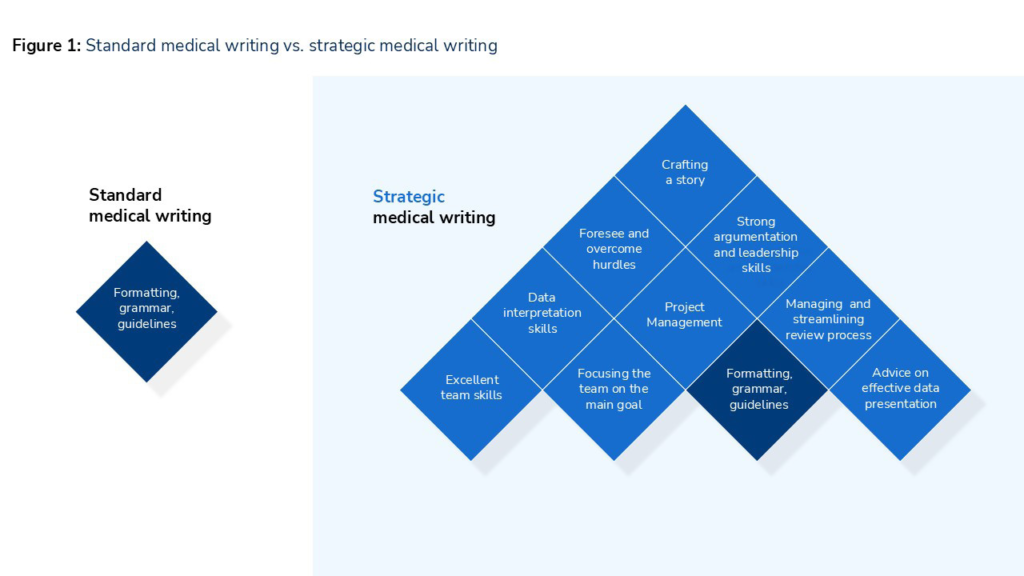
An essential part of the strategic element comes from understanding the big picture of clinical development: where it starts, where it is going, and the possible hurdles to be expected along that road. A strategic medical writer has the experience and knowledge to advise a clinical team on how to accommodate for potential hurdles in advance and how to communicate about them afterwards. For example, a medical writer who has helped several clinical teams address the lack of certain, relevant data that would have been informative in the context of their submission dossiers can suggest to future teams to consider collecting this data when writing the protocols for future programmes in similar indications. From the experience of discussing the gap in the storyline of the original dossiers caused by the missing data, the strategic medical writer is already thinking about how to avoid similar gaps in future dossiers while designing new protocols.
Another strategic element comes from the medical writer’s ability to guide a team to have discussions about challenging topics, thereby highlighting and elucidating the core elements of risks, benefits, weaknesses and strengths of a clinical programme. The ability to pull these topics together and develop a well synthesised discussion is critical to communicating the benefit-risk evaluation of a clinical programme, and this is a key indicator of a good and experienced medical writer.6
The strategic medical writer strives to eliminate topics and argumentation that are tangential to the main story of a document, or the targeted label of a submission dossier. If a team is considering and discussing issues that are not relevant to the purpose of a document, for example exploratory subgroup analyses that show no trends and have no impact on the content of the planned label, the medical writer will guide them back to those topics that are critical to produce a document that will give a reviewer what is needed. The writer is always helping the team remember their goal, whether it be acceptance by an editor or approval of a product label. Applying strategic medical writing keeps the focus on the target and helps teams from getting too far off track from that.
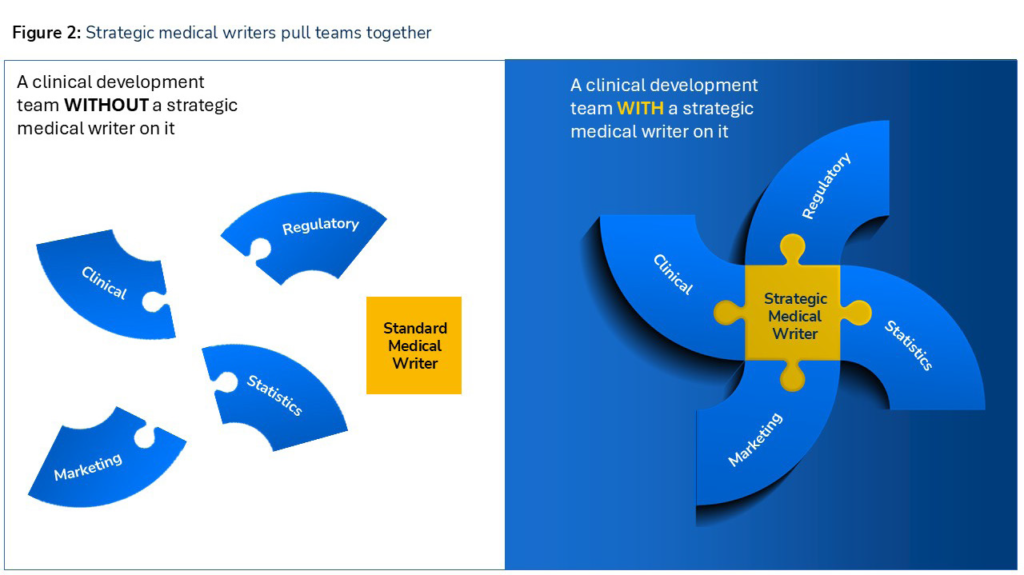
In addition, the strategic medical writer will endeavour to get input from all functions on a team (regulatory, statistics, clinical, pharmacovigilance, marketing, etc) while helping mediate cross-functional differences of opinion on what messages the data has to say. Writing scientific documents as a truly collaborative process, rather than the individual effort of a particular author, is not the way many clinicians and academics learned how to write. As a result, it does not come naturally to many members of clinical teams.7 Strategic medical writers often serve as a kind of glue on clinical teams (Figure 2). They pull team members together by focusing them on the common goal of funnelling all their ideas to produce a unified document. This is achieved partially by suggesting effective data presentations and clear texts that make the meaning easy to understand and partially by having appropriate and effective interpersonal skills. Strong argumentation and leadership skills are necessary to challenge and guide a team to find the best way to present what can be complex data sets and tell the story consistently and clearly, sometimes across multiple documents.
A further cornerstone of strategic medical writing is the ability of the medical writer to keep the process of writing documents from losing momentum or stagnating by means of effective project management. The strategic medical writer develops clear timelines with their team at the kick-off meeting, with real dates and time for review cycles that are developed in agreement with the team members. By planning each stage of the writing process in advance, the whole team can schedule in each stage of the writing process and be ready for them as they arrive. This includes scheduling in review times well in advance to be sure the authors set aside enough time to review the documents properly (rather than at 2am when they are exhausted) and deliver their input in a timely fashion.
Beyond project management, the strategic medical writer helps teams understand how to effectively review a document.8 They ensure each functional reviewer knows exactly where their input is needed and thereby save team members from focusing on things that are unnecessary or have already been agreed to by the team.
Thus, in contrast to standard medical writing, strategic medical writing tackles the many hurdles encountered in the communication process as a whole. It offers a clinical team solutions to what can be an unwieldy and often an anxiety-ridden endeavour. Ultimately it is about developing functional teams who can work together to achieve a common goal: a document that says what it should, in the way it should (tailored to the specific audience), and gets done on time.
The future of strategic medical writing
With the rapid increase in the number of development programmes and the ever stricter and more complex regulatory requirements over the last two decades, strategic medical writing is no longer just a nice-to-have.9,10 Strategic medical writing is essential to maximise the likelihood of the success of any clinical development programme, by making sure that the agency reviewers get documents that help them understand the full scope of the product they are assessing.
With the recent rise of generative artificial intelligence (AI) in the medical writing space, strategic medical writing has taken on a further relevance: it will soon be the only type of medical writing left to be done. While AI is not yet capable of taking over all the non-strategic activities in medical writing, it soon will be.11-13 In a survey performed by the American Medical Writers Association, 42% of medical writers were already using generative AI to perform some aspect of their work in 2024.14
The AI tools available today can string together remarkably eloquent texts describing the data. They can review a document and identify inconsistencies (providing these in a nice tabular format for comparison). They can create flow charts from text or table upon command. They can fairly accurately populate the methods section of a clinical study report from a clinical study protocol and the statistical analysis plan. Pulling information together is now something that can be done by technology in a fraction of the time it takes a human to do it manually. While these outputs are not error-free, AI can even be used to check the outputs for errors.
What the AI cannot do is the strategic part of the process. AI cannot rally a team together, project manage, mediate meaningful debates about the messages the data have to tell, or ask the right questions to ensure the focus stays on track. So, as many of the standard activities of medical writing are being taken over by AI, what remains is the really interesting part of our role as medical writers – providing the strategic support to the authoring teams.
Strategic medical writing is essential to maximise the likelihood of the success of any clinical development programme, by making sure that the agency reviewers get documents that help them understand the full scope of the product they are assessing.
Conclusion
The term ‘medical writing’ evokes different things for different people. Standard medical writing arose from the need to help physicians bring data to paper and ensure that documents comply with guidelines. Strategic medical writing goes beyond this in many ways, with the writers functioning as communication specialists and advisors who provide strategic insight to the documentation process. They help communicate key messages across dossiers and entire development programmes and make sure teams stay focused on a common goal. Ultimately, they help turn what can be a quagmire of communicating unclear data and endless review cycles into a structured and guided experience to craft effective documents. Strategic medical writing is not a new phenomenon – many medical writers have embraced and rehearsed it for decades as the medical writing profession has evolved. As AI rapidly takes over the routine aspects of medical writing, the age of the strategic medical writer is fully upon us. The true value of the profession now lies in confidently embracing and mastering the strategic dimension of the role. Are you ready for it?
References:
- Visit: trilogywriting.com/wp-content/uploads/2022/09/11_Strategic-Benefits_Julia-Forjanic-Klapproth_ICT_Nov2011.pdf
- Lang T, ‘Medical writing: where it’s been, where it’s going’, AMWA Journal, 15(2), 2000
- Ford J D et al, ‘From medical writer to communication specialist: expanding roles and contributions in pharmaceutical organizations’, AMWA Journal, 19(2), 2004
- Limaye N 2010, ‘Outsourcing medical writing: the evolution of a niche domain’, PharmaTimes, 42(08)
- Harris D et al (2021), ‘Optimizing the Value of Regulatory Medical Writers’, AMWA Journal, 36(4)
- Visit: bpb-us-w2.wpmucdn.com/sites.udel.edu/dist/7/419/files/2013/01/UsingWritingToGuideScienceTC2000.pdf
- Visit: trilogywriting.com/document/strategicbenefits/
- Forjanic Klapproth J (2025), ‘Good Review Practice – The New Panacea’, Journal for Clinical Studies, 16(4)
- Visit: fda.gov/media/74352/download
- Visit: csdd.tufts.edu/sites/default/files/2025-02/May2015%20Profiles%20of%20New%20Approaches%20to%20Improving%20the%20
Efficiency%20and%20Performance%20of%20Pharmaceutical%20Drug%20Development%20.pdf?1759845206 - Byram J K (2024), ‘Communicating about and with artificial intelligence applications’, AMWA Journal, 39(2)
- Pickett J et al (2024), ‘Take the leap! Steps to integrate AI into your work’, AMWA Journal, 39(2)
- Visit: indegene.com/what-we-think/reports/generative-ai-life-sciences-lessons-pathforward
- Nicosia M (2025), ‘How Freelance Medical Writers and Editors Use Digital Tools: Results From the 2024 Freelance Medical Communicator Tools of the Trade Survey’, AMWA Journal, 40(1)