Type: Publications

ICT-May-2022
How to Streamline Regulatory Authority Meetings
Streamlining meetings with regulatory authorities is a continually evolving process. But what role do briefing documents play, and what is the best way to produce these effectively?
Author: Maria Mascarenhas and Barry Drees
Journal: International Clinical Trials
Date: May 2022
OCT-2022-Cover-Page
How to streamline a complex process: why experienced medical writers will add value to oncology dossiers
Oncology is one of the most common areas of drug development in the pharmaceutical industry. In 2020, many of the new drugs approved by the FDA were cancer treatments. Existing...
Author: Julia Forjanic Klapproth and Maurice Löwens
Journal: Clinical Operations in Oncology Trials Handbook 2022
Date: December 2021
ICT-Cover-Page-November-Edition
The FDA, EMA, and PMDA Questions: How to Respond During Review of CTD Submission Dossiers
While the ICH’s Common Technical Document (CTD) is an internationally agreed format for preparing application dossiers needed for obtaining approval to market a drug, the ensuing review process is specific to the country or region in question. Irrespective of the differences in process between countries and regions, questions will almost always be issued during the review process, with a request for written responses.
Author: Douglas Fiebig
Journal: International Clinical Trials
Date: November 2021
Journal-for-Clinical-Studies-Volumne-13-edition-5
Plain Language Summaries of Publications – what has COVID-19 taught us?
The COVID-19 pandemic has significantly impacted the whole world and the public has had to struggle with understanding scientific data on a daily basis. The impact of scientific misunderstanding became painfully apparent with the decline in vaccine uptake and so the need for clear, understandable scientific information has never been more vital.
Author: Lisa Chamberlain James and Rachel Beeby
Journal: Journal for Clinical Studies
Date: October 2021
H1-Journal-Front-Page
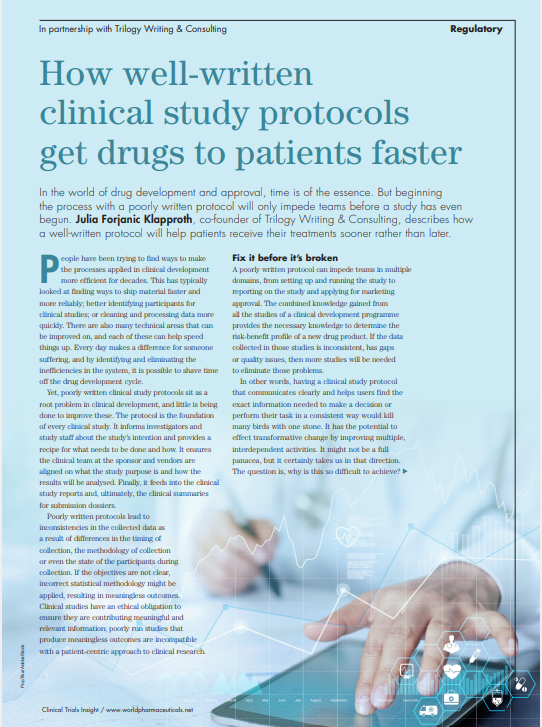
Reaping the Benefits from Improved Clinical Study Protocols
Clinical study protocols are important cornerstones on the journey of collecting the clinical data needed to elucidate the benefit-risk profile of medical treatments/devices. Not only do they lay down the plan for the study at hand, they serve as a repository of knowledge for the strategic intentions and will be used for multiple down-stream activities. They are the basis for trial registration, provide guidance to those running the study, and will be used by participants, ethics committees/institutional review boards, funders, regulators, journal editors, and systematic reviewers to appraise the study.
Author: Julia Forjanic Klapproth
Journal: H1 Virtual Events: Review and Summary Handbook
Date: June 2021
Clinical-Trials-Insight-July-2021
Lean Medical Writing: Story not Storage
The most difficult task an author can face is clearly summarising a complex and data-filled clinical regulatory document and explaining the data. Barry Drees, co-founder and senior partner of Trilogy Writing & Consulting, discusses the recent concept of ‘lean medical writing’ (LMW), and how it is being implemented and used in the pharmaceutical industry.
Author: Barry Drees
Journal: Clinical Trials Insight
Date: June 2021
JCS-Summer-2021
Communicating with Patients. Who and How?
Despite the fact that patient-friendly versions of many regulatory documents are now mandated by the regulations, the most frequently encountered reaction to communicating patient information is apathy.
Author: Lisa Chamberlain James
Journal: Journal for Clinical Studies
Date: June 2021
EPC Journal
The Clinical Development Plan – The Importance of Getting it Right
Given the extreme complexity and difficulty of developing new pharmaceutical products, one would think that the planning for such an endeavour would be taken very seriously. Yet, somewhat surprisingly, it frequently is not.
Author: Barry Drees and Julia Forjanic Klapproth
Journal: European Pharmaceutical Contractor, EPC
Date: November 2020
Regulatory-Rapporteur-Article-67-Cover
Do We Need to Involve Patients in Clinical Study Report Lay Summaries?
Translating complex clinical regulatory documents into versions that are understandable to patients and the general public was never going to be an easy task, but it is a very necessary, important, and now legally mandated one. This article argues that the advent of the clinical trial results lay summary requirement has highlighted the need for patient involvement in clinical trials at the very earliest stages.
Author: Lisa Chamberlain James and Barry Drees
Journal: Regulatory Rapporteur
Date: Vol. 17, Issue 9, September 2020
ICT-Magazine-The-Future-Awaits-Us-Article-May-2020
The Future Awaits Us
Off the back of the release of Trilogy Writing & Consulting’s second special edition magazine, EPC sits down with Barry Drees to expand on medical writing trends in the industry....
Author: Barry Drees
Journal: European Pharmaceutical Contractor, EPC
Date: May 2020
Medical-Device-Developments-2020_Vol.1-Cover
The Clinical Evaluation Report: Document Writing and Compilation
Trilogy offers high-end medical writing that goes beyond just making sure a document is structured properly: it involves content-driven sanity checks, a sense of ownership of the documents  and offering...
Author: Gerard McGregor
Journal: Medical Device Developments
Date: 2020, Volume 1
Medical-Writing-Special-Edition-2-Front-Cover
Help Reviewers Tell You What They Want
Reviewers of regulatory documents need to ensure that their comments are specific, actionable, and relevant, so that no critical time is spent unnecessarily throughout the document development process. Review is...
Author: Diana Radovan
Journal: Medical Writing Special Edition No. 2
Date: February 2020
Medical-Writing-Special-Edition-2-Front-Cover
Writing for Patients: When and How
In a drive for more patient-centric healthcare practices, medical writers are increasingly required to present medical and health information in an easy-to-understand, ‘plain language’ format. The move towards patient engagement and patient involvement in healthcare decisions (‘shared care’) has triggered a raft of new guidances from regulatory authorities.
Author: Lisa Chamberlain James, Deborah Collyar, Allen Todd, Catina O'Leary
Journal: Medical Writing Special Edition No. 2
Date: February 2020
Medical-Writing-Special-Edition-2-Front-Cover
Truth be Told: Where AI and Automation Can Really Take Us
AI and automation are both exciting and daunting prospects in the future of medical writing, but the advantages of these tools should be scrutinised, as well as what they mean...
Author: Julia Forjanic Klapproth and Angela Russell Winnier
Journal: Medical Writing Special Edition No. 2
Date: February 2020
Medical-Writing-Special-Edition-2-Front-Cover
The Clinical Evaluation Report: Bringing it Together
In light of recent regulations, it is important to discuss the general aspects and strategies for writing and compiling a CER. In Europe, a clinical evaluation report (CER) is now...
Author: Gerard McGregor
Journal: Medical Writing Special Edition No. 2
Date: February 2020
Medical-Writing-Special-Edition-2-Front-Cover
Taming the Complexity of Preparing CTD Submission Dossiers
Process optimisation and effective management and organisation strategies are essential components when preparing CTD submission dossiers for drug approval. “Be prepared.” In his book, Scouting for Boys, Robert Baden-Powell introduced...
Author: Douglas Fiebig, Johan Telen
Journal: Medical Writing Special Edition No. 2
Date: February 2020
Medical-Writing-Special-Edition-2-Front-Cover
Implications of Policy 0070 for the Writing of Clinical Dossiers
EMA Policy 0070 requires the publishing of all clinical reports submitted as part of MAAs, so it is important to highlight what new challenges this may bring for the writing...
Author: Julia Forjanic Klapproth, Jo Anne-Marie Blyskal
Journal: Medical Writing Special Edition No. 2
Date: February 2020
Medical-Writing-Special-Edition-2-Front-Cover
Achieving a Work-Life Balance as Medical Writers
In any industry, there is considerable evidence of the value and improved productivity for those who maintain a healthy work-life balance, and we should not forget that a near total...
Author: Barry Drees
Journal: Medical Writing – A Bold New Path: The Future Awaits Us
Date: February 2020
Medical-Writing-Special-Edition-2-Front-Cover
Medical Writing - A Bold New Path: The Future Awaits Us
The second edition of Trilogy’s special edition magazine, Medical Writing – A Bold New Path: The Future Awaits Us, was published at the beginning of 2020. Once again, Trilogy Writing...
Journal: Special Edition of International Clinical Trials, ICT
Date: February 2020
CTI2019.2
Lay Summaries and Writing for Patients
The most recent changes to regulatory legislation in terms of information for patients – the introduction of the lay summary of the risk management plan (RMP) and the lay summary of clinical trial results (CTRs) – have caused great discussion and concern in an industry very willing to provide information to patients, but more used to producing complex scientific information for regulatory authorities (RAs).
Author: Lisa Chamberlain James and Trishna Bharadia
Journal: Clinical Trials Insight
Date: Winter 2019